
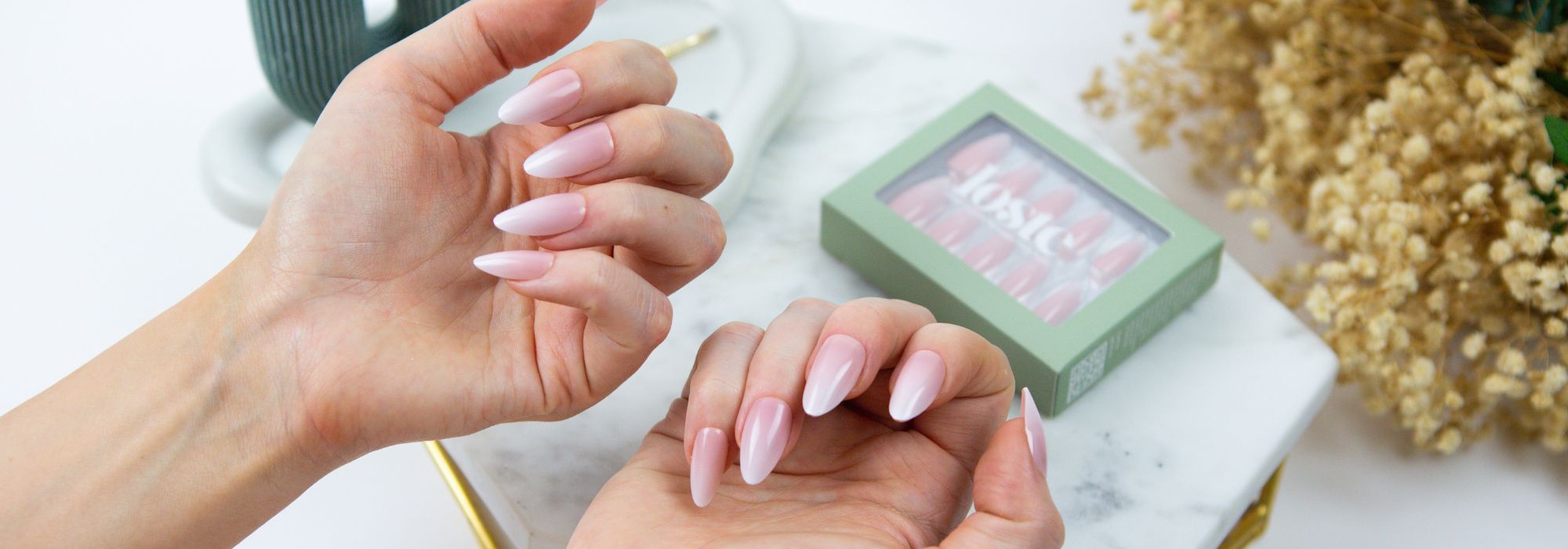


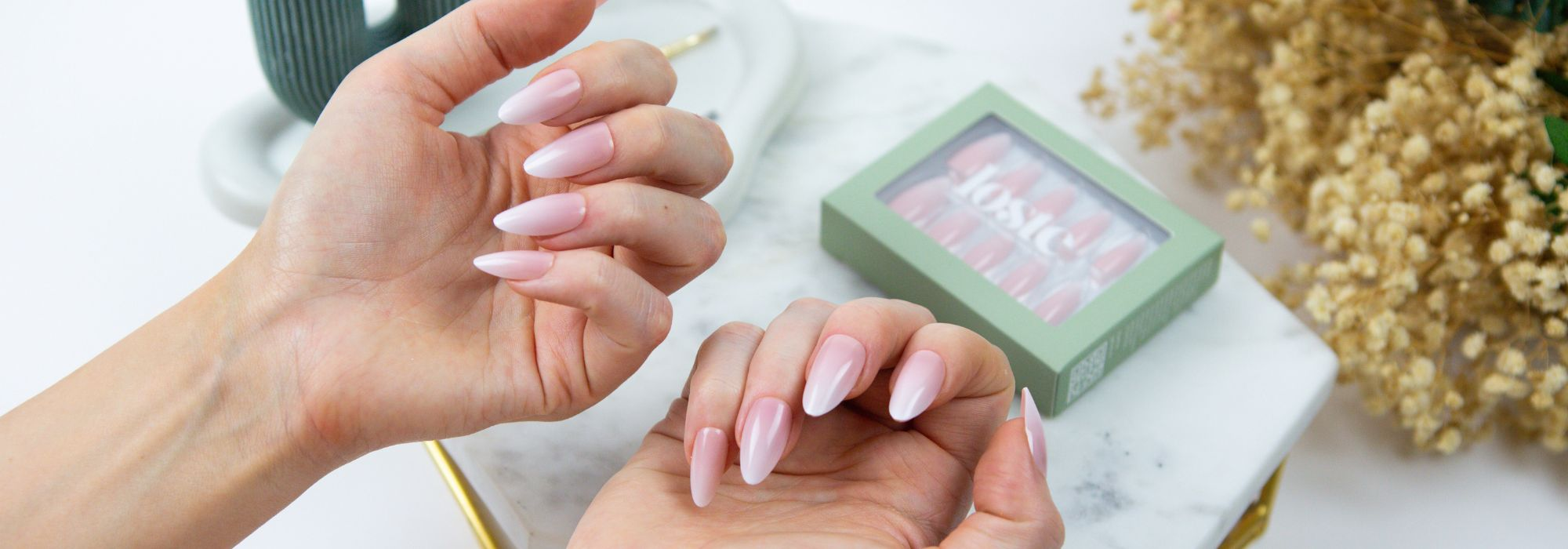


If you have never found a set that covers your thumb, or every set looks too big on your little fingers, the problem is the fit, not your nails. A press-on looks like your own nail when it sits just inside your side walls: almost as wide as your nail, never so wide that it touches your skin. Width matters most, and curve comes a close second. Every Loste kit has 15 sizes, from 0 (the widest) to 14 (the smallest), two of each. Here is how to get width and curve right for your nail beds, with every size in millimetres.
You don't need to measure before you order: each kit has 15 sizes, and our almond sets cover nails from about 7 to 14 mm wide. If your thumb is wider, Short Round goes to 15.1 mm and Short Squoval to 16.4 mm. Measuring matters most at either end of the range.
When your kit arrives, match each finger using the number printed under each nail: our guide How to Apply Loste False Nails shows you how.
Which press-on nails fit your nail beds: the short answer
- Wide nail beds: check your widest nail, usually the thumb, against size 0, our widest. Size 0 is 14 to 14.5 mm across in our almond shapes, 14.6 mm in Short Square, 15.1 mm in Short Round and 16.4 mm in Short Squoval. If your thumb fits an almond, almond makes a wide nail look longer and slimmer; if not, choose Short Round or Short Squoval. If your nail beds are long as well as wide, choose square: it covers more of your nail.
- Press-ons keep lifting? The size is usually wrong: too wide and the edge rests on your skin, too narrow and it springs up. Check whether your nails are flat or curved (below), then size each finger.
- Small or narrow nail beds: size 14, the smallest, is 6.3 to 7.3 mm across, depending on the shape. If a nail is still a little too wide, file its sides gently until it sits within your nail.
- Flat nail beds: size up and file the sides, rather than squeezing into a smaller nail, and use glue rather than sticky tabs to fill any gap in the middle.
- Curved nail beds: take the smaller size, as long as it presses down comfortably.
- Short nail beds: choose a short length, in a round or squoval shape, that reaches no further past your fingertip than your own nail is long.
- Long nail beds: some shapes can leave a gap at the base on a very long nail bed. If yours do, choose a longer set, such as Long Almond.
- Whatever your nails: match each finger to its size. Between two sizes, curved nails take the smaller one and flat nails the larger one, filed to fit.
Flat or curved? How to tell
To tell whether your nail beds are flat or curved, look straight at your fingertip, end on: a deep C means curved, and a shallow arc, like a bracket lying on its side, means flat. It is easier to see than to measure, and it decides which size to take when you are between two.

Press-on nail sizes: how Loste sizing works
Every Loste kit holds 30 nails across 15 sizes, two of each, one set for each hand. Size 0 is the widest and size 14 the narrowest, and each nail has its size number printed on the underside, so laying out a set takes a minute.
The rule: for each finger, choose the size that matches the width of your nail, so it sits just inside your side walls and never on your skin. If you are between two sizes, the curve of your nail decides:
- Curved nails: take the smaller size, as long as it presses down comfortably. A hair's gap at each side is what you want: an edge that reaches your skin lets water in, and that is where lifting starts.
- Flat nails: take the larger size and file its sides. A smaller press-on on a flat nail is squeezed out of shape, presses on the nail and pops off sooner.
A press-on that is a little wide can be filed to fit; one that is too narrow can never be made wider. Before you glue, lay the whole set out and dry-fit each nail: press it on without adhesive to check the width. Every kit includes a nail file and a cuticle stick, and our guide How to Apply Loste False Nails covers preparing your nails and applying the set.
Every Loste size in millimetres, measured flat, straight across the nail. A size number is a different width in each shape, so check the column for the shape you are buying.
| Size | Classic Almond | Short Almond | Long Almond | Short Round | Short Square | Short Squoval |
|---|---|---|---|---|---|---|
| 0 (widest) | 14 mm | 14.2 mm | 14.5 mm | 15.1 mm | 14.6 mm | 16.4 mm |
| 1 | 13 mm | 13 mm | 13 mm | 14.4 mm | 13.4 mm | 14.7 mm |
| 2 | 12.5 mm | 12.3 mm | 12 mm | 13.8 mm | 12.4 mm | 13.4 mm |
| 3 | 12 mm | 11.7 mm | 11.9 mm | 12.6 mm | 12.1 mm | 12.9 mm |
| 4 | 11 mm | 10.6 mm | 11 mm | 12.2 mm | 10.8 mm | 12.2 mm |
| 5 | 10.5 mm | 10.5 mm | 10.6 mm | 11.4 mm | 10.7 mm | 11.2 mm |
| 6 | 10 mm | 10 mm | 10.1 mm | 10.5 mm | 10.3 mm | 10.6 mm |
| 7 | 9.5 mm | 9.7 mm | 9.4 mm | 10.1 mm | 9.9 mm | 9.93 mm |
| 8 | 9 mm | 9.4 mm | 9 mm | 9.8 mm | 9.4 mm | 9.5 mm |
| 9 | 9 mm | 9.3 mm | 8.6 mm | 9.8 mm | 8.8 mm | 8.9 mm |
| 10 | 8.5 mm | 9.1 mm | 8.3 mm | 9.1 mm | 8.5 mm | 8.5 mm |
| 11 | 8.5 mm | 8.6 mm | 7.7 mm | 9 mm | 8 mm | 8.2 mm |
| 12 | 8 mm | 8.1 mm | 7.3 mm | 8.4 mm | 7.6 mm | 7.6 mm |
| 13 | 7 mm | 7.6 mm | 6.7 mm | 7.6 mm | 7.2 mm | 7.1 mm |
| 14 (smallest) | 7 mm | 7.3 mm | 6.3 mm | 7.1 mm | 6.9 mm | 6.6 mm |
Editor's Note: Your two hands are rarely identical. A kit has one nail of each size per hand, so measure both and lay out each hand on its own.
How to measure your nails for press-on nails
Measure each nail straight across its widest point, from side wall to side wall, in millimetres. Hold a millimetre ruler flat across the nail rather than laying a tape over it, and measure every finger on both hands.
A tape follows the curve of your nail, so it reads wider than a measurement taken straight across: our Classic Almond size 0 is 14 mm measured flat but 21 mm along its curve. Our size table is measured flat, straight across, so measure your nails the same way.
Press-on nails for wide nail beds
Wide nail beds need a set whose widest sizes are wide enough, and a shape that flatters them. Check your widest nail against size 0 in the table above.
The shape: we recommend almond. The gentle taper towards the tip draws the eye along the finger, so the hand looks longer and the nail slimmer. If your nail bed is long as well as wide, choose square instead. An almond narrows towards its tip, and on a long nail bed that taper starts while it is still over your nail, so the sides of your own nail can show. A square keeps its full width to the end and covers them.
When to choose Short Round or Short Squoval: our almond shapes have the narrowest size 0 in the range, 14 to 14.5 mm. If your widest nail is wider than that, Short Round's size 0 is 15.1 mm, and Short Squoval's, the widest in our range, is 16.4 mm.
If a nail is wider than every size 0: a press-on can be filed narrower but never made wider, so a nail wider than 16.4 mm is wider than any nail we make, and a set that is too narrow pinches and lifts. Please message us before you order.
Your thumb
The thumb is usually the widest nail on the hand, and the one most often left without a nail that fits. Measure it on its own: when your hand lies flat, your thumb nail turns to the side and looks narrower than it is, so press your thumb flat on the table, as you would for a thumbprint, and measure it there. If your thumb measures wider than our widest size in the shape you want, try Short Round or Short Squoval.
Press-on nails for small or narrow nail beds
Small nail beds need the narrow end of the range. Size 14, our smallest, is 6.3 mm across in Long Almond and up to 7.3 mm in Short Almond, so the shape you choose decides how small the set goes.
If a nail is a little too wide, you can narrow any press-on with a fine file. File each side from the underside, so the file never grazes the colour or the shine on top, a few light strokes at a time, and check the fit against your nail as you go. Small strokes keep the edge smooth and stop it chipping. The aim is a nail that sits just inside your side walls, never on your skin.
Every Loste kit includes these small sizes, and no one has yet told us the little-finger nail was too big. If you are unsure, measure your smallest nails before you order and compare them with the table above.
Press-on nails for flat nail beds
On a flat nail, a curved press-on can touch at the sides first and leave a small gap in the middle, which lets it rock and lift. So on flat nail beds, follow the rule above: the larger size, filed to fit.
Glue fills the gap in the middle better than a sticky tab, so on flat nail beds we suggest glue. Every Loste kit includes both Ultra Strong Press-On Nail Glue, for up to 14 days' wear, and sticky tabs, for a few hours to 3 to 5 days. On other nail beds, choose by how long you want to wear the set: How Long Do Press-On Nails Last? Glue vs Sticky Tabs compares the two.
Loste press-ons have a medium curve, so they sit best on average to curved nails. On a flatter nail, the larger size and glue make up the difference.
Press-on nails for curved nail beds
Curved nails suit a snug fit: the smaller size, as in the rule above, as long as it presses down comfortably and leaves a hair's gap at each side. A press-on that is flatter than your nail touches in the middle and stands away at the sides, which is where lifting starts.
Press-on nails for short nail beds
Short nail beds suit short lengths. A short round or squoval nail has less tip to catch on things, so it is less likely to pop off. As a guide, the press-on should reach no further past your fingertip than your own nail is long. Our short shapes are Short Round and Short Squoval, plus Short Almond and Short Square if you prefer a tapered or straight tip: see every set in Short Press-On Nails.
Bitten or very short nails can wear press-ons too. Many people wear them while their own nails grow, and a short length looks the most natural over a short nail bed. If your nails are recovering from acrylics or gels, The Art of Nail Recovery covers getting them back to health.
Press-on nails for long nail beds
On a long nail bed, some shapes can leave a small gap at the base, between the press-on and your cuticle. If that happens, choose a longer set, such as Long Almond: see our long press-on nails. If your nail bed is wide as well as long, choose square instead: an almond's taper can leave the sides of your nail showing, and a square covers them.
When a Loste set may not fit you
We would rather tell you now than after you have opened a set. If a nail measures wider than 16.4 mm, our widest size, or narrower than 6.3 mm, our smallest, please message us before you order. If a kit does not suit you, send it back within 14 days in its original condition, unopened and unused so we can sell it again, and we will refund you (our refund policy). Trying nails on means opening the set, so it is worth checking your sizes first.
Press-on nail fit: your questions
What size press-on nails do I need?
Measure each nail straight across its widest point and choose the size that sits just inside your side walls. Every Loste kit has 15 sizes, two of each, so each finger gets its own size; between two, take the smaller one on a curved nail and the larger one, filed, on a flat nail.
Are my nail beds flat or curved?
Look straight at your fingertip, end on. A deep C means curved; a shallow arc, like a bracket on its side, means flat.
Why do press-ons never fit my thumb?
The thumb is usually the widest nail on the hand, and often wider than a set's largest size. Loste's size 0 runs from 14 mm in Classic Almond to 16.4 mm in Short Squoval. Measure your thumb on its own, pressed flat, with a millimetre ruler held straight across it.
What if press-on nails are too small for my nails?
Go up a size: a press-on that is too narrow pinches and lifts. If your nail is wider than our widest size, 16.4 mm in Short Squoval, message us before you order.
Why does the smaller size hurt?
A press-on that is too narrow, or too curved for a flat nail, squeezes your nail and the pressure builds over the day. Take it off, go up a size, and file the sides gently from underneath until it sits just inside your side walls.
Why do my press-on nails keep popping off at the sides?
Most often the size is wrong. One that is too wide rests on your skin, where water gets under the edge; one that is too narrow is forced out of shape and springs up. Leave a hair's gap at each side, file the sides if it is slightly wide, and on a flat nail size up and use glue rather than a tab. If the size is right and they still lift, our guide How to Apply Loste False Nails covers preparing your nails.
Are my nail beds too short for press-ons?
No. Short and even bitten nails can wear press-ons; choose a short length, in a round or squoval shape, so it looks natural and stays put.
Find your set
Once you know your shape and your sizes, browse every Loste set. Each kit holds 30 nails across 15 sizes, with glue, sticky tabs, a nail file and a cuticle stick, so you can apply it the day it arrives.
Read next:


